Categories
Uncategorized

Monday Minute: Growing Up Twice-Exceptional in the 1980’s

What does twice-exceptional look like?

As a young child, I was extremely quiet, could polish whole chapter books off in a day, and spent my young years compiling 20 journals in which I religiously recorded my thoughts and experiences. At the very mature age of 10, I would utilize post-it notes stuck to my desk lampshade in order to record all of the ideas that I would get, most often and inconveniently at bed-time, where I found it difficult to turn off my brain. These post it notes served as a holding bin and quite literally demonstrated the phrase ‘Stick a pin in it.’ I was “different’ than my peers, usually finding certain topics so interesting that I would become a little expert on them. By the age of eight, I adored my babysitter’s high school text books that she brought over to complete her homework. Time with adults was my safe space, as they never commented or made fun of my advanced vocabulary.

What many did not realize is that I also spent the better parts of second, third, and fourth grade unable to complete any of my school work. I have distinct memories for the duration of these years, of wondering why, yet again, I could not get my work done like the other kids who got to go out to recess. I, instead, would be spending another recess with my never-ending list of unfinished assignments. Although I have memories of making patterns out of the numbers on the paper or creating storylines for the pictures on the work page, I did not connect these things to not getting my work done. And for a long time, no one helped me connect those dots. I was left to wonder how the other kids did it, because I assumed they also made patterns and created storylines and managed to get their work done. It didn’t cross my mind that they simply focused. Some might say I was “bored.” Maybe, but that answer was too simple. In retrospect knowing what I know now, I realize that my brain was breaking up a task that felt tedious. In a way, by stopping throughout the worksheet to do something my brain enjoyed, I was breaking up the overwhelm and providing myself with a little “preferred activity” reward.

I so desperately wanted to know what the other kids got that I just didn’t. I could not, for the life of me, understand why I struggled to keep things organized, even with the best of intentions. I probably more resembled a charming, but unorganized professor, with my stack of books by my bed, some having been read multiple times. It wasn’t until the middle of my fourth grade year, that a teacher finally took action and informed my parents that I had a list of about 20 unfinished assignments. It was the first my parents had heard of it. I had always maintained A’s. I suppose I was graded on the fact that I could read many grade levels ahead of my age or that writing was something that I could almost feel. I loved writing so much and reveled in using newly noticed author’s craft from texts I had read. Playing with the syntax of a sentence was like a game for me and I loved to try a sentence several different ways just to see how it could change the impact of the words. Yes, at the age of nine. I also believe it was because I was quiet. At all costs, I avoided getting my name on the board. But finally, someone was willing to reflect these challenges in my grades. My parents worked with the teacher to immediately create a system, walked beside me as I completed unfinished work, and presented me with an incentive which forever helped to establish the habits that led to being a doctoral student with a 4.0. Most important, I don’t remember being in trouble. My parents did NOT let me know how disappointed they felt, even though I am sure they felt that and so much more… worry, confusion, frustration, upset they didn’t know earlier.

This was not the end of challenges for me. It created a platform and I grew. But I still struggled through my jr. high years to figure it out and many times learned the hard way. I had to become aware of the things that were difficult for me and I found ways to compensate.

Have compassion for our littles that are gifted and the unique challenges they face. The asynchronous development. The ones who simply don’t understand why their vocabulary of a 20-year-old does not fit inside the frontal filter of a seven-year old. They are our future thinkers, inventors, creators, yet they are one of our most underserved and misunderstood populations. They will not work for companies; they will create companies. They will not follow ideas; they will create ideas and advocate. It is not for us to decide a child’s future but to help them reach their potential. To walk alongside them and to help them connect the dots in the unique way that works for them. And by the way…these characteristics are now my superpowers. I still adore and swear by post-it notes and seek to advocate for our twice-exceptional youth!

If you would like some guidance for your twice-exceptional child, I would love to walk alongside you and bring my expertise to help! Check out my 1:1 coaching sessions where I customize strategies to help you meet the needs of your family at http://www.deannawestedt.com.

Categories
Uncategorized

Monday Minute: How do I help my young child be ready to read?

This is a question I hear so often, and while phonics play an important role in literacy development there is so much more to laying the foundation for children’s success on the path to reading.

Read on for ways to pave the path to literacy (no flashcards required!):

  1. Include some rhyming songs and games in your day: silly word play is not only fun, but it also builds important pre-literacy skills to prepare students to substitute and manipulate phonemes (sounds) in oral language which in turn prepares them to use word chunks and blending to read new text. Fun tunes like the Name Song (Billy Billy Bo Milly…) and reading nursery rhymes (bonus points for clapping every time you say a rhyming word!) are very impactful ways to build up students’ readiness for reading!
  2. Access to lots and lots of books! Although books can be expensive, you don’t have to spend a fortune (or anything at all, really!) to provide an array of texts for reading and enjoyment.  The public library is a great resource for accessing a variety of children’s literature and often, they have a little store where extra copies or donated books are sold at very low prices, sometimes as low as 25 cents a book. Libraries and bookstores often have reading incentive programs, too, where a free book is the prize. Also, consider partnering with other parents for a book exchange.
  3. Building your child’s vocabulary. Aside from reading aloud to your child, which has been shown to greatly increase a child’s vocabulary exponentially, providing experiences that promote new words and dialogue help, too! Baking, gardening, a visit to the park, or a walk in the neighborhood are all great opportunities to build your child’s vocabulary simply by talking about what is around you.

If you would like more information on early and pre-literacy strategies, schedule a customized 1:1 coaching session with me on my oncehub link, right here on my website or email me at deanna@deannawestedt.com. My coaching sessions utilize a proprietary blend of techniques and tools I have built over 21 years of experience and through teaching my own two boys. I would love to have the opportunity to share those with your family!

Categories
Uncategorized

Monday Minute: Collaborative Parenting for ADHD and Behavioral Challenges

The first time we ever used collaborative parenting strategies in our family, I was very literally near the end of my parenting rope! I had gone into parenting thinking I would have this parenting thing down ( I thought). As a teacher, I understood consistency, holding children accountable; I was the teacher they sent other teachers to in order to see how to manage a class. Surely if I could do that with more than 20 children, I could do that with 2 of my own! (LOL forever, my friend).

I will never forget the feeling of success it brought to sit down with my child and empathetically listen to his perspective and the resulting collaboration that resulted in less stress for the entire family.

Transitions were very difficult for my son, especially when it came to favorite activities. And, at the time, nothing was more of a favorite than legos. Anytime we had to transition from legos, the nightmare would ensue. I thought I knew what was going on… he loved legos, right? Of course he didn’t want to stop! I pulled out every parenting “strategy” in the book. But once I dove into that collaborative conversation with him, boy was I in for a surprise! It turns out that in his very complex mind in which he would become completely hyper-focused and absorbed, he was afraid that he might not remember where he left off! He might not remember where to start up again! Wow! I had never thought of it like that before! This insight guided our whole language we used to discuss this and eventually we came up with the agreement to have space and time to find a “stopping point.” It is a term that has served us well in many situations since, but had I not had that conversation with him, I would have probably stayed in the cycle of constant dread everytime we had to shift activities or leave the house!

Admittedly, within the world of nueroscience and education we are in the very earliest stages of truly understanding the human mind and how it develops. The more we learn about it, the more evidence there is to show that the commonly accepted reward/ consequence system does not always work, especially for brains that are differently wired.

The good news is that collaborative parenting is an approach that aligns with preparing children with behavioral challenges to learn skills for navigating adulthood. Here are some answers to commonly answered questions about the collaborative parenting approach:

Q: By using collaboration with my child, does it undermine my authority as a parent?

A: Absolutely not! In fact, there is evidence that using these strategies encourages children to listen and come to parents with their concerns when they know their parent will look through a collaborative lens. Also, there is never a question that in issues of safety and health concerns that you must act in a role of authority. If my boys find it difficult to accept and comply with a family rule put in place for their safety ( for instance with technology), we may have a discussion about why it is hard for them and get to the bottom of the unsolved problem, but that doesn’t mean we will change the rule entirely. It doesn’t mean that we won’t have to take a break from technology. Also, in the collaborative process, there is a step that involves sharing your concern with your child and why it is important to you. The modeling of communication here is extremely powerful and strengthens the relationship between parent and child.

Q: If I use collaborative structures, am I able to still provide accountability for my child?

A: Yes! Collaborative structures include reviewing the agreed upon solution to further problem solve and aligns with natural consequences of choices that children make. It overlaps with gentle parenting and viewing the child from a holistic perspective. As adults, we may have many assumptions of what is causing behavior, but once collaborative structures are used, most experience surprise that there was something else at the root of the problem from the perspective of the child. Most importantly, these structures teach important soft skills such as interpersonal relations, communication, problem solving, and reflexivity that are highly valued in both in relationships and in the work environment.

If you want more information on how to implement these parenting strategies with your child, contact me at deanna@deannawestedt.com or sign up for a consult at deannawestedt.com. You can schedule right on my oncehub link. I look forward to walking with you and your family through these impactful steps.

Categories
Uncategorized

Monday Minute: What’s Your Homeschool Style? Why not to stress what others may think!

Build a homeschool style for your family that’s as unique as your family is!

The community of homeschooling is as diverse in the way it looks as the reasons for which families choose to homeschool. But as I have immersed myself in the homeschool lifestyle, I have started to notice a trend in which the definition of homeschooling is taken apart and dissected to the point where it undermines the actual purpose of homeschool: freedom and choice to do what is best for your child and your family! According to The Best Schools, there are seven identifiable categories of homeschooling: Classical, Charlotte Mason, Montessori, Unschooling, School-at-Home, Unit Studies, and Eclectic.

We personally fall into the eclectic category. Based on my sons’ goals and interests we have forged and selected a trajectory for their homeschooling that works for us. We take some school at home classes for their core subjects to meet A-G requirements for high school level classes because they have both expressed a desire to follow career paths that may lead them to college. They are enrolled in college classes through dual enrollment. We incorporate classical subjects, including Bible, for which I have chosen the curriculum. Additionally, two days a week we have an unschooling format for at least a portion of the day for the boys to pursue their own projects. From Charlotte Mason, we include lots of nature, flexible learning environments, and short work windows. Our weeks include travel, outings, and exploring different activities and sports.This is what works for us and I would not ever expect any other family to follow exactly our blueprint. My boys, like every other individual, have a unique learning fingerprint, as unique as their thumb print. Between the two boys, we don’t even do things identical.

From my perspective, as long as your plan for your children leads to an emotionally healthy family life for everyone involved, then you are taking the right path…

Is your child working ahead or behind the conventional education system because that’s what they need? Fantastic! Welcome to homeschooling!

Do you use standards to help guide your learning? That’s fine too! You’re welcome in the homeschooling community, as well!

Do you find that incorporating co-op and other opportunities for your child gives a fullness to your day, even if nothing more than to get some time to think your thoughts? (Introverts, I know you understand!) Wonderful! You belong in the homeschool community, too!

Does your child have special needs for which you have chosen to bring in supports or extra help? Go on with your wonderful homeschooling self!

Does your child take school-at-home classes or attend a hybrid program? You fit in, too!

You see, you do not have to do it any other person’s way, because you are educating your children and you know them and your family situation best!

As homeschoolers, we face enough critiques from others. Isn’t it time to support each other in the homeschool world as we move along our personal journeys? Imagine what we could get accomplished if we collaborated, supported, and shared resources without fear that someone would come along and define homeschool for us.

If you want more guidance into how to assess your family’s needs to design a path of homeschooling as unique as your children, reach out to me at deanna@deannawestedt.com Whatever your family’s goals for homeschooling, I can help you meet them. You can also connect with me right here on my website by scheduling a free consult on my OnceHub link located on the parents tab.

Categories
Uncategorized

Monday Minute: Top 3 Suggestions for When Your Homeschool Day is Tough

Pinterest and Facebook picture perfect aside, every homeschooling parent encounters their challenges. In fact, I would bet it is safe to say that behind every successful homeschool story, there are a few tumultuous days here and there. But sometimes, the homeschooling waters can seem rougher than usual. What’s a parent to do when their homeschool day goes off-line?

  1. Take a step back and do a quick assessment. Just as you would with a young infant, assess whether there are factors such as hunger or the need for a movement break. Behavior is communication and even our children who are old enough to verbalize may not always developmentally have the filter and processing to think through what it is that would make them feel better. Not only do these things address physical needs that could contribute to some behavior challenges, but they also allow for a brief resetting of the mind.
  2. Take a step back from schoolwork. If frustration has taken over the learning day, it may be time to take a break from academics, at least for a few minutes. Allowing your child to do something that is calming such as going outside, reading a book, or listening to music can be immensely helpful. As the parent, you can set the parameters on this and even decide in advance with your child what activities might help them to calm a frustrated brain.
  3. Relationship build. Even in the busyness of a day, 5 minutes spent doing something with the child outside of school work that is of the child’s choosing can strengthen the relationship and create a bond outside of the day to day “must-do’s.” Also, making a tradition or habit of finding at least three genuine positive praises to say to your child everyday will reinforce a positive connection that can help balance out the relationship.

These suggestions are great for mild and infrequent issues that spring up naturally from time to time, but if you are experiencing constant defiance in the homeschool relationship, it may be time to try some more intensive collaborative structures. Contact me at deanna@deannawestedt.com for a free consult to talk about how I can help empower you in your homeschool journey. Or sign up right here on my website on the parent tab on my OnceHub link!

Also, check out my upcoming virtual webinar on addressing homeschool challenges with collaborative structures.

Categories
Uncategorized

Monday Minute: Flexible Seating- A Positive Solution

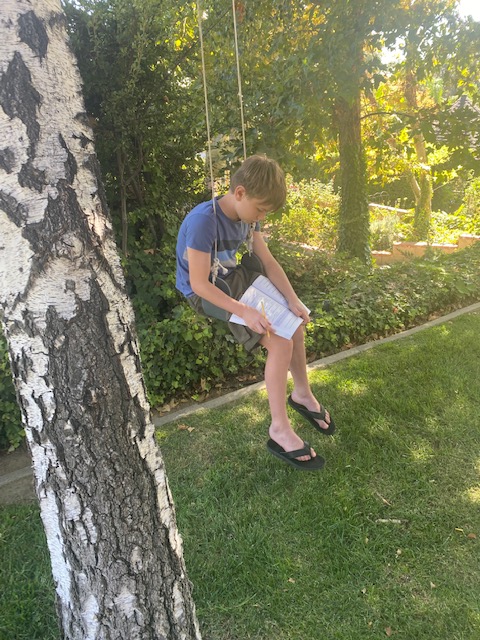
Swings provide proprioceptive movement for children as they learn!

Homeschooling provides the unique opportunity to customize learning to our children: an outside the “classroom box” approach that has the potential to uncover true joy in learning for those who previously didn’t fit within that classroom box (FYI: some of our world’s most inventive thinkers admittedly did NOT fit within the classroom box).

Flexible seating is one way we can customize learning for our children! Without the constraints of maintaining a classroom of children, as homeschoolers we have the opportunity to provide options in the when and where of learning. Here are some tips and insights:

  1. Flexible seating can actually teach children to self-regulate their learning! By allowing children to explore how and where they best learn we teach them to understand how to regulate their learning environments and potentially think towards careers that would best suit them. In certain fields, flexible work space is the name of the game!
  2. Explore tools for flexible seating through occupational therapy retailers online.
  3. But you can actually do flexible seating for free by just allowing your child to work outside if that best suits them (forest bathing has been shown to contribute to calm) or to stand or sit in various locations as desired.
  4. Flexible seating does not have to be (nor should it be) a free for all unless that is absolutely working for your family dynamics. Parameters to work within are generally helpful for families. If a parent is working from home this might also influence the set up. Talk it over as a family, try different things out, and revisit the set-up as necessary.
  5. Although flexible seating is often thought to benefit children with certain types of nuerodiversity, and while that is often the case, the truth is that many types of individuals can benefit from exploring how they best work!

If you are interested in learning more about how to collaborate with your children for a healthy homeschool experience, contact me for a free consult at deanna@deannawestedt.com or schedule right here on my website on the “parents” tab!

Categories
Uncategorized

Monday Minute: I have ADHD. Can I be a successful homeschool parent?

Yes! Absolutely! Here are some tips to approach homeschooling if you are the one with ADHD:

1.The first step is recognizing this about yourself and understanding the ways it impacts your day to day. The great (and daunting) thing about homeschooling is that we get to lead by example, but it is in these moments of finding strategies and working to find a solution for our challenges we set the best example of all. That’s right, our challenges (which by the way are often also our strengths) can be the best opportunity to showing our children how to be successful in our day to day life.

2. Reflect on solutions to address the challenges, then try them for a week. Flexibility is the name of the game when it comes to homeschool and there are as many ways to homeschool as there are fingerprints. No one way looks alike…nor should it. If you thrive off of structure find the balance that works for you without it becoming overwhelming. If your child needs flexible space, meet them in the middle on it.

3. Set small goals and write them down! The journey to the goal is what it is all about and that journey will invariably have twists and turns. If you find yourself off-track one week (or several weeks) operate with grace for yourself. This self-compassion is a wonderful thing to exemplify for our children. Also, when we don’t expect perfection from ourselves, we are more likely to pick ourselves back up when we get off track. And that also is worth a thousand academic lessons!

If you are ready for more information and want to learn more about strategies for learning in the home, sign up for a consult right here on my website deannawestedt.com. Go to the parents tab and click on my oncehub link! Or send me an email at deanna@deannawestedt.com

Categories
Uncategorized

Literacy in the Home Setting: Homeschool and Beyond

7,419 Homeschool Photos - Free & Royalty-Free Stock Photos from Dreamstime

Whatever path you take for education, the home is the first place children connect to the path to literacy. We, as adults, often connect literacy and learning to read to the term “education” which in turn is all too often connected to a formal school setting. But the truth is that the most meaningful learning happens in real life context. And what better place for that than the home setting.

That is not to say that children do not need direct instruction in literacy. Every child’s path to literacy looks a little different. If you are a homeschool parent, you know that teaching your children in the way that works best for them is critical. Homeschooling (or any home-based learning) must reflect compassion, flexibility, and grace. And this philosophy is so important in establishing a healthy relationship to reading and writing. Here are my top suggestions for making that happen:

  1. Use a Balanced Literacy Approach. The path to literacy is soooo much more than phonics. Are you reading to your children? That is literacy learning. They are learning Concepts About Print (Things we take for granted like which way to read and to go to the next line). This can be done in the very comfort of the basic read aloud time in a way that connects literacy to happy memories rather than focusing on “instruction.”
  2. Focus on yourself as the facilitator of literacy. This puts the parent/ teacher in the place of role model. Research on reading development shows that children learn best through shared experiences. In the world of literacy we call these shared writing (shared pen) and shared reading. Modeling for your child and allowing them to take parts of the task that they can do for themselves, like point to the words or write the words they do know is critical.
  3. Real life literacy experiences. One of children’s major life tasks is to emulate adults and learn from pretend play. This spills over into literacy development. Providing children with real life reading and writing opportunities is also important. This can be done by providing them with pretend play opportunities where they may write a grocery list ( using invented spelling or even made up spelling). They may copy words off of boxes in the pantry to learn to use resources. The goal here isn’t for perfect spelling or reading, but rather application of what they do know! There are so many ideas for center learning ideas which inspire true literacy learning through play.

If you are ready for more information and want to learn more about how to do balanced literacy in the home, sign up for a consult right here on my website deannawestedt.com. Go to the parents tab and click on my calendly link! Or send me an email at deanna@deannawestedt.com

Categories
Uncategorized

Rejective Sensitive Dysphoria: The Unrecognized Symptom of ADHD

It is an unfortunate fact that our young humans that possess a differently wired brain tend to hear a lot about what they don’t do right. Parents, teachers, and other caretakers often experience understandable frustration. Also unfortunate is the fact that the ADHD child often is much more sensitive to correction than their nuerotypical peer, feeling it as a personal rejection. They feel reprimands deeply and profoundly.

This fact, combined with the knowledge that typical reward and consequence type systems do not help the ADHD brain correct maladaptive behaviors, should lead us to use alternative methods to prevent permanent damage children. Remember, their brain is wired differently. We wouldn’t expect a child who needs to wheelchair to walk up steps. In the same way, we must sometimes “ramp it up” for children with ADHD by providing them with supports that help them develop the skills they are delayed in.

When you teach and parent, you touch the future and that is a pretty amazing place to be.

For more ideas on how to create accessible learning for the ADHD brain, contact me at deanna@deannawestedt.com.

Categories
Uncategorized

The Tip of the ADHD Iceberg

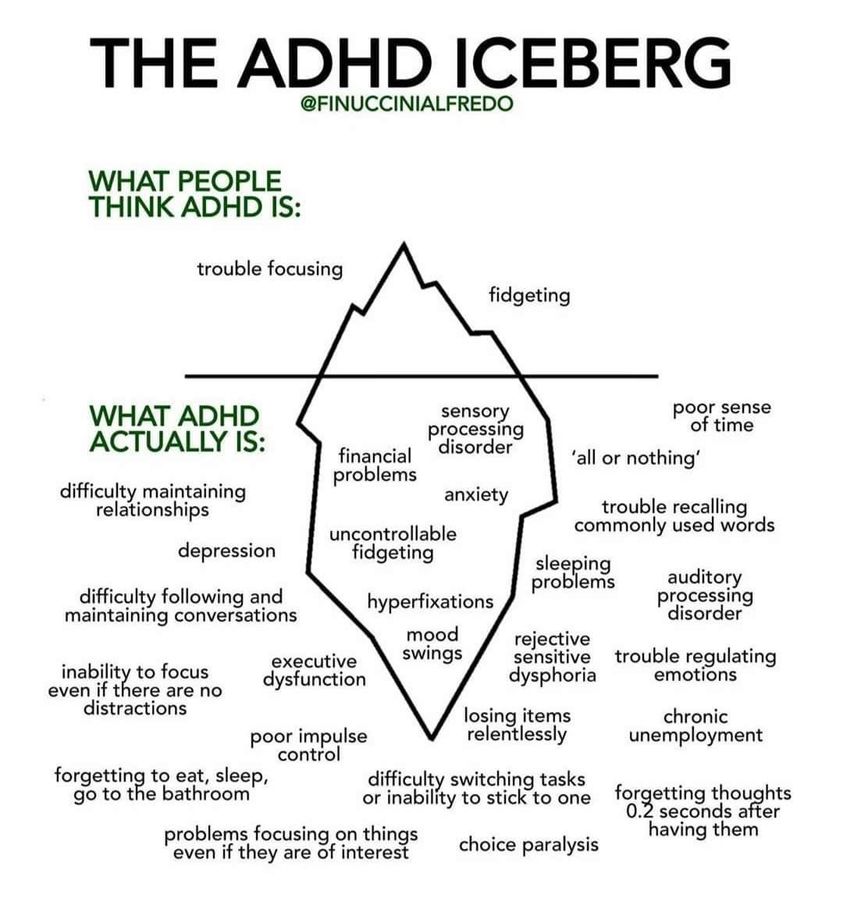
This last week I’ve discussed the challenges of invisible disabilities, including ADHD. Today, I want to touch on the misconception that ADHD is simply about hyperactivity and maladaptive behaviors such as fidgeting and not completing work. These are, of course, stereotypical behaviors associated with ADHD and due to the challenges the present in parenting and teaching an ADHD child they probably garner the most attention. However, if the Titanic is any indication, it is what lies beneath the surface that can be incredibly impactful.

Although not every child who has this diagnosis experiences every single symptom or attribute, it is incredibly important for caregivers to understand the underlying challenges. Doing so can completely change the lens of the adults caring for children who have ADHD, once again changing their behaviors from being “naughty” or “incorrigible” to being part of their differently wired brain. And while we very much want to address these challenges for students ( I mean, we don’t want to say not being able to to keep a job potentially is just a symptom), understanding the the child is not trying to struggle and make life difficult can be a breath of fresh air, take out the personal feeling that the child’s behavior feels like (yes, we are human , too), and relieve the frustration.

The ability to identify the specific and lesser known ways that ADHD may affect your child or a student can help you provide scaffolding (think a step ladder) to help them build the skills they need to function successfully in a world, that will not necessarily bend to their unique challenges. Our goal is to create a human that has the skills to be healthy, happy, and successful out in the world and this is a VERY attainable goal for the child with ADHD. Not only can the child with ADHD be able to survive they can be successful in whatever pathway they choose. In fact, if tapped into properly, I would venture to say they have the chance to be incredibly successful in their chosen path because the way their brain is wired often makes them incredibly passionate about their interests, often working leaps and bound beyond their nuerotypical peers. It is our role to help them identify their passions, give them the tools, and help them develop the skills that do not come naturally to them. This IS a big ask. You will get frustrated. You won’t handle every situation textbook. But, the process of raising and educating our children is to also model resiliency and most of all communicating that they will not be given up on.

When you parent and teach, you touch the future and that is a pretty amazing place to be!

Visit me at https://deannawestedt.com/parents/ for more information on how I can help you and your child navigate their learning!